Showing posts with label pigments. Show all posts

16 October 2010

Articles on X-ray Analysis (1997-2007)


Advances in X-ray Analysis (AXA) are the proceedings of X-ray conferences organised by The International Centre for Diffraction Data (ICDD).
The articles are freely available to download from their website, except for the volumes from 2008 and 2009.
I made a selection of the articles related with cultural heritage:


Advances in X-ray Analysis, Vol. 51, 2007

Analysis of Pigments Used in a Japanese Painting
(pdf)
Y. Hayakawa, S. Shirono, S. Miura, T. Matsushima

Microscanning XRF, XANES and XRD Studies of the Decorated Surface of Roman Terra Sigillata Ceramics (pdf)
C. Mirguet, P. Sciau, P. Goudeau, A. Metha, P. Pianetta, Z. Liu, N. Tamura


Advances in X-ray Analysis, Vol. 50, 2006

Non-Destructive Analysis of a Painting, National Treasure in Japan
(pdf)
Y. Hayakawa , S. Shirono, S. Miura, T. Matsushima, T. Uchida


Advances in X-ray Analysis Vol. 49, 2005
Identification of Painting Materials Used for Mural Paintings by Image Analysis and XRF
(pdf)
S. Shirono, Y.Hayakawa


Advances in X-ray Analysis, Vol. 47, 2003

Analysis of Art Objects and other Delicate Samples: is XRF Really Non-Destructive? (pdf)
M. Mantler, J. Klikovits

Applications of X-Ray Diffraction in Conservation Science and Archaeometry
(pdf)
M.-C. Corbeil
Design of EDXRF Equipment for the Nondestructive Study of Prints
(pdf)
M. Ardid, J.L. Ferrero, C. Roldán, D. Juanes, J.L. Lluch, R. Vives, P. Punter
Portable XRF Analysis of Japanese Historical Objects
(pdf)
Y. Hayakawa

Synchrotron Applications in Archaeometallurgy: Analysis of High Zinc Brass Astrolabes
(pdf)
B. Newbury, B. Stephenson, J. Almer, M. Notis, G.S. Cargill, III, G.B. Stephenson, and D. Haeffner
X-Rays in Art and Archaeology - An Overview
(pdf)
M. Schreiner, B. Frühmann, D. Jembrih-Simbürger and R. Linke


Advances in X-ray Analysis, Vol. 46, 2002

Identification of Forged Works of Art by Portable EDXRF Spectrometry
(pdf) M. Ardid, J.L. Ferrero, D. Juanes, C. Roldán, M. Crespo, M.E. Pernett, M. Marzal, M. Burke, S. Rovira, R. Vives


Advances in X-ray Analysis Vol. 44, 2000

Analysis of Pigments used in Scroll Paintings of a National Treasure "Tale of Genji" using a Portable X-Ray Fluorescence Spectrometer
(pdf)
K. Sugihara, K. Tamuara, M. Satoh, Y. Hayakawa, Y. Hirao, S. Miura, H. Yotsutsuji, Y. Tokugawa

EDXRF Analysis of Pigments of Works of Art from the Spain's Cultural Heritage
(pdf)
J.L. Ferrero, C. Roldan, D. Juanes, C. Morera, and E. Rollano


Advances in X-ray Analysis Vol. 42, 1998

Applications of Micro XRF for the Analysis of Traditional Japanese "Ainu" Glass Beads and other Artifacts
(pdf)
K. Sugihara, M. Satoh, Y. Hayakawa, A. Saito and T. Sasaki


Advances in X-ray Analysis Vol. 41, 1997

Evaluation of Monolithic Polycapillary X-Ray Lenses for sub-mm Local XRF Analysis of Artistic Objects
(pdf)
B. Vekemans, K. Janssens , G Vittiglio, F. Adams, L. Andong and Y. Yiming

Micro-analysis of Artists’ Pigments by Grazing-Emission X-ray Fluorescence Spectrometry
(pdf)
Martine Claes, Rita Van Ham, Koen Janssens and René Van Grieken


16 July 2010

Enamels and enamelling (1900)


Title: Enamels and enamelling, an introduction to the preparation and application of all kinds of enamels for technical and artistic purposes, for enamel makers, workers in gold and silver and manufacturers of objects of art
Author: Paul Randau
Publisher: Scott, Greenwood and co.
Year: 1900
Pages: 236
Types of files: pdf, djvu, txt, epub, kindle, daisy
Link: http://www.archive.org/...

Note: Resource kindly indicated by Nina Horvat

Table of Contents (short version):

I. Introduction
II. The Composition and Properties of Glass
III. Raw Materials for the Manufacture of Enamels
IV. Substances Added to Produce Opacity
V. Fluxes
VI. Pigments
VII. Decolorising Agents
VIII. Testing the Raw Materials and Enamel Mass
Ix. Subsidiary Materials
X. Preparing the Materials for Enamel-Making
XI. Mixing the Materials
XII. The Enamel Mass
XIII. Appliances for Smelting the Enamel Mass
XIV. Smelting the Charge
XV. Composition of Enamel Masses
XVI. Composition of Masses for Ground Enamels
XVII. Composition of Cover Enamels
XVIII Preparing the Articles for Enameling
XIX. Applying the Enamel
XX. Firing the Ground Enamel
XXI. Applying and Firing the Cover Enamel or Glaze
XXII. Repairing Defects in Enamelled Ware
XXIII. Enamelling Articles of Sheet Metal
XXIV. Decorating Enamelled Ware
XXV. Specialties in Enamelling
XXVI. Dial-Plate Enamelling
XXVII. Enamels for Artistic Purposes

26 June 2010

Articles: Journal of Cultural Heritage 11


Full-text articles available for free download


Title: Journal of Cultural Heritage
Reference: Journal of Cultural Heritage, Volume 11, Issue 1, Pages 1-118 (January-March 2010)
Link: http://www.sciencedirect.com/...

Table of contents:

Original articles

A practical approach to making accurate 3D layouts of interesting cultural heritage sites through digital models
Pedro Martín Lerones, José Llamas Fernández, Álvaro Melero Gil, Jaime Gómez-García-Bermejo, Eduardo Zalama Casanova
Pages 1-9 (pdf, 1604 Kb)

Desalination of masonry structures: Fine tuning of pore size distribution of poultices to substrate properties
Barbara Lubelli, Rob P.J. van Hees
Pages 10-18 (pdf, 1312 Kb)

Assessing stains on historical documents using hyperspectral imaging
Douglas Goltz, Michael Attas, Gregory Young, Edward Cloutis, Maria Bedynski
Pages 19-26 (pdf, 2210 Kb)

Identification of red colorants in van Gogh paintings and ancient Andean textiles by microspectrofluorimetry
Ana Claro, Maria J. Melo, J.Sérgio Seixas de Melo, Klaas Jan van den Berg, Aviva Burnstock, Meredith Montague, Richard Newman
Pages 27-34 (pdf, 707 Kb)

Non-invasive characterisation of binding media on painted glass magic lantern plates using mid-infrared fibre-optic reflectance spectroscopy
Rebecca Ploeger, Dominique Scalarone, Oscar Chiantore
Pages 35-41 (pdf, 932 Kb)

From 3D reconstruction to virtual reality: A complete methodology for digital archaeological exhibition
Fabio Bruno, Stefano Bruno, Giovanna De Sensi, Maria-Laura Luchi, Stefania Mancuso, Maurizio Muzzupappa
Pages 42-49 (pdf, 1093 Kb)

Microscopic and spectroscopic techniques for the study of paper supports and textile used in the binding of hispano-arabic manuscripts from Al-Andalus: A transition model in the 15th century
Teresa Espejo, Adrian Duran, Ana Lopez-Montes, Rosario Blanc
Pages 50-58 (pdf, 978 Kb)

Physical principles and efficiency of salt extraction by poulticing
Leo Pel, Alison Sawdy, Victoria Voronina
Pages 59-67 (pdf, 625 Kb)

Seismic vulnerability of natural stone pinnacles on the Amalfi Coast in Italy
Gian Piero Lignola, Emidio Nigro, Edoardo Cosenza
Pages 68-80 (pdf, 3693 Kb)

Harvesting community annotations on 3D models of museum artefacts to enhance knowledge, discovery and re-use
Jane Hunter, Anna Gerber
Pages 81-90 (pdf, 1108 Kb)

A methodological approach in the evaluation of the efficacy of treatments for the dimensional stabilisation of waterlogged archaeological wood
Gianna Giachi, Chiara Capretti, Nicola Macchioni, Benedetto Pizzo, Ines Dorina Donato
Pages 91-101 (pdf, 776 Kb)

Nanolime suspensions applied on natural lithotypes: The influence of concentration and residual water content on carbonatation process and on treatment effectiveness
Valeria Daniele, Giuliana Taglieri
Pages 102-106 (pdf, 229 Kb)

Case Studies

Structural engineering and geology applied to the static problems of the Etruscan “Tomba dell’Orco” (Tarquinia, Central Italy)
Salvatore D’Agostino, Gianni Lombardi, Gianpiero Russo, Carlo Viggiani
Pages 107-112 (pdf, 1015 Kb)

Natural lighting in the Hall of Two Hundred. A proposal for exhibition of its ancient tapestries
Carla Balocco, Elena Frangioni
Pages 113-118 (pdf, 921 Kb)

02 June 2010

Article: Feasibility of analyzing molecular pigments in paint layers using TOF S-SIMS (2005)


Title: Feasibility of analyzing molecular pigments in paint layers using TOF S-SIMS
Authors: Rita Van Ham, Luc Van Vaeck, Freddy Adams, Annemie Adriaens
Reference: Analytical and Bioanalytical Chemistry 383, 2005, 991–997
DOI: 10.1007/s00216-005-0088-4
Link: http://hdl.handle.net/... (pdf, Mb)

Abstract:
A first attempt to measure the molecular compositions of pigments in paintings using static SIMS was made. An investigation of pellets of pure pigments such as auripigment and verdigris allowed the detection of numerous high m/z ions useful for molecular identification. Analysis of pigments in embedded paint fragments, on the other hand, only yielded elemental information because of charge build-up and contamination problems. Optimization of the form in which the sample is presented to the analysis method is obviously the price to pay for the ultimate sensitivity and information depth of S-SIMS.

06 May 2010

Article: Conservation of Feathers (2005)

Title: Considerations in the Conservation of Feathers and Hair, Particularly their Pigments
Author
: Jocelyn Hudon

Reference
: Fur Trade Legacy. The Preservation of Organic Materials, M. Brunn and J. A. Burns (ed.), Canadian Association for Conservation of Cultural Property, Ottawa, Ontario, 2005, pp. 127-147.

Link
: http://www.royalalbertamuseum.ca/... (PDF file, 4 Mb)


Abstract
:
Feathers are amongst the most complex epidermal derivatives found in vertebrates. They have complex branched structures, grow from their bases by a unique mechanism, and come in a wide variety of sizes, shapes, structures, and colours. Not only do feathers impart cover, insulation, waterproofing of the body, contribute to flight, tactile sensations or protection of sensory organs, even storing water, they are also involved in myriad aspects of communication and display in birds, and characteristically rather ornately. Underlying this diversity of colours and patterns found in birds is a variety of pigments (melanins, carotenoids, psittacofulvins, porphyrins, etc.), pigment-bearing structures and molecules, and complex micro- and macrostructures.
Given the great structural and functional diversity of feathers it should come as no surprise that their conservation should require a multifaceted approach. Accordingly, a brief review of feather anatomy, including the arrangement of feathers on the skin (pterylosis), chemical composition, even the native fauna of feathers (e.g., lice, mites, bacteria) will be provided, emphasizing aspects of feathers that may be of relevance to conservators. Since cleaning methods are well covered by other speakers, my focus will be on the preventive conservation of feather and fur colour from light. I will show how even pigment systems that seem biochemically homogenous—like the melanins of mammals—show surprisingly complex and species-specific responses to light. For example, in pilot fading experiments, mink, but not marten, fur darkened initially upon exposure to light. Attempts to quench free radicals likely generated by light irradiation did not appear to slow fading down.

05 May 2010

Thesis: Raman spectroscopy applied to iron oxide pigments (2008)

Title: Raman spectroscopy applied to iron oxide pigments from waste materials and earthenware archaeological objects
Author
: Malebogo Andries Legodi

University
: University of Pretoria

Year: 2008
Type of Document
: PhD Thesis

Link
: http://up.ac.za/... (pdf)


Abstract:
Raman spectroscopy is a vibrational spectroscopic technique. It gives a unique combination of non-destructive analysis, high spatial resolution and phase characterisation. In the current study Raman spectroscopy was used as the primary technique during the study of chemical components in archaeological earthenware samples (i.e. low temperature fired clay pottery) of South African and Chinese origin, and characterisation of iron oxides derived from mill scale. One shard from each of the South African archaeological sites (Rooiwal, Lydenburg, Makahane and Graskop) was analysed by Raman spectroscopy, FT-IR spectroscopy, X-ray fluorescence (XRF) spectroscopy and X-ray diffractometry (XRD). The common features observed were montmorillonite (Mg3(Si,Al)4(OH)2.4.5H2O[Mg]0.35), kaolin (Al2Si2O5(OH)5), quartz (α-SiO2), feldspar (K- and NaAlSi3O8), hematite (α-Fe2O3), calcium silicate (CaSiO3) and illite (KAl4(Si7AlO20)(OH)4). Gypsum (CaSO4.2H2O) and calcium carbonates (CaCO3) were detected in Lydenburg, Makahane and Graskop shards. Amorphous carbon was observed in Lydenburg and Makahane shards while rutile appeared only in Makahane shard. The Lydenburg and Rooiwal shards showed the presence of anhydrite (CaSO4). The Chinese clay samples investigated by Raman spectroscopy were from the J A Van Tilburg museum at the University of Pretoria. The large red shard was recovered from the 1552 Portuguese shipwreck, São João, found around Port Edward, South Africa. Four other shards (two red and two gray) were recovered from the 1622 Portuguese shipwreck, the São João Baptista, found around Kenton-on-Sea off the South African coast. A 19th century Chinese teapot was also analysed. Hematite, kaolin, quartz, amorphous carbon and aluminosilicates were observed in all three red shards. All these components, except quartz, were also observed in the teapot. The gray shards showed the presence of quartz, kaolin, amorphous carbon and aluminosilicates. The pigments identified were hematite (in red samples) and black amorphous carbon (in all samples). Magnetite and goethite were precipitated from mill scale-derived precursors in aqueous media. Hematite was then prepared from the calcination of goethite at 750°C and maghemite from the thermal treatment of magnetite at 200°C. The iron oxides were characterised by Raman spectroscopy, XRD, surface area determination and scanning electron microscopy (SEM). They were generally composed of very small sized particles showing high surface area values.

Table of contents (short version):
1. Overall Introduction

2. Literature Review

3. Raman Spectroscopy

4. Raman Spectroscopy study of ancient South African domestic clay pottery

5. Raman analysis of red-brown and gray shards from 16th and 17th century Portuguese shipwrecks

6. The preparation of magnetite, goethite, hematite and maghemite of pigment quality from mill scale iron waste

7. Overall conclusion

03 May 2010

Thesis: caractérisation des pigments et des mélanges de pigments (2004)

Title: Couleur de la matière picturale : caractérisation des pigments et des mélanges de pigments, effets induits par l'adjonction de liant et de charges
Author
: Guillaume Dupuis

University
: Université Paris Sud - Paris XI
Year: 2004 Pages: 296
Type of Document
: PhD
Link: http://archives-ouvertes.fr/... (pdf, 7.8 Mb)

Abstract
:
La spectroscopie de réflectance diffuse dans le domaine du visible est une technique paradoxalement rarement utilisée pour identifier les matériaux des couches picturales des oeuvres d'art. Quand elle est malgré tout mise en oeuvre, l'identification de pigments à partir de ce type de mesures repose toujours sur la comparaison avec une base de données spectrophotométriques de pigments de référence. Au sein du Centre de Recherche et de Restauration des Musées de France, la base de données est composée des spectres de réflectance de pigments purs, secs et en poudre. Une couche picturale est au contraire constituée de pigments parfois mélangés et dispersés dans un liant. Ces deux caractéristiques des couches picturales ont permis de distinguer deux axes de recherche pour le travail de thèse. I. La caractérisation des mélanges de pigments La modélisation de Kubelka-Munk s'est avérée pertinente pour la gamme usuelle des couleurs utilisées dans les oeuvres d'art, et ce même dans le cas extrême des mélanges dans lesquels un des composants est nettement minoritaire. Il est à présent possible, pour un mélange binaire, de déterminer les composants du mélange dans la majorité des cas par traitement numérique des mesures spectrophotométriques. Une fois la nature des composants déterminée, il est de plus systématiquement possible d'en retrouver les proportions relatives. Les résultats obtenus sur les échantillons modèles ont pu être adaptés au cas d'une oeuvre d'art : la Vierge d'Annonciation attribuée à Giovanni di Paolo. Dans ce tableau italien du XVe siècle, la couleur du visage est réalisée à partir d'un mélange de blanc de plomb et de vermillon a tempera. Les proportions relatives calculées de ces deux pigments sont en accord avec ce qui est observable au microscope optique sur des prélèvements et mesurable ensuite par traitement des images. II. L'influence du liant Des échantillons de couches picturales ont été réalisés par un artiste selon une recette traditionnelle. La concentration de pigments et le nombre de couches de matière picturales varient selon les échantillons. Ces derniers ont été étudiés parallèlement en spectrophotométrie, en diffractométrie des rayons X et en microfluorimétrie X. Les résultats obtenus par ces méthodes d'analyse concordent. La méthode de Rietveld d'affinement des diffractogrammes permet notamment d'aboutir à des valeurs de concentration de pigment dans le liant tout à fait en accord avec les résultats obtenus par la modélisation de la propagation de la lumière dans les milieux absorbants et diffusants utilisée pour interpréter les mesures spectrophotométriques. L'aboutissement de ce travail de thèse devrait permettre aux scientifiques de la conservation, aux historiens d'art et aux restaurateurs d'envisager la spectrophotométrie comme une technique d'analyse qualitative et quantitative, sans prélèvement, sans contact et réalisable in situ, qui fournit la nature et les proportions des différents constituants de la matière picturale.

Table of Contents (short version):
I. Couleur de la matière picturale

II. Instrumentation

III. Modélisation

IV. Mélange de poudres
V. Mélange de gouaches

VI. Adjonction de liant
Conclusion générale

23 April 2010

Article: the effects of white pigments and extenders (1990)


Title: Studies on the photochemical stability of synthetic resin-based retouching paints: the effects of white pigments and extenders
Authors: Paul M. Whitmore and Catherine Bailie
Reference: Cleaning, retouching and coatings: Contributions to the 1990 IIC Congress, Brussels, 1990, pp. 144-149
Links: http://www.cmu.edu/... (pdf, 568 Kb)

Abstract:
The durability of a paint vehicle can be strongly influenced by the pigments which it contains. This report describes an initial investigation of the photochemical degradation of paints formulated with a commercial poly(n-butyl methacrylate) and a variety of white pigments and extenders. Upon exposure to near-ultraviolet (UV) light, this resin predominantly cross-links, eventually becoming almost completely insoluble. White pigments such as rutile TiO2 and Green Seal zinc oxide do not alter this tendency but they do slow the cross-linking rate, probably by their ability to absorb UV light. By contrast, a nonabsorbing light scatterer like barium sulfate increases the rate of cross-linking, perhaps by increasing the path length of light as it becomes diffused within the paint film. Finally, pigments such as anatase TiO2 and Kadox 515 zinc oxide not only decrease the overall degradation by screening UV light, but also increase the relative importance of chain-breaking chemistries through their photocatalytic properties. Even so, loss of volatile degradation products renders these films as insoluble as the purely cross-linked systems.

Thesis: Case studies of Naples Yellow and discoloured Smalt (2003)


Title: Scientific analysis of historical paint and the implications for art history and art conservation. The case studies of Naples Yellow and discoloured Smalt.
Author: Joris Dik
University: University of Amsterdam
Year: 2003
Pages: 159
ISBN: 9090164790
Type of document: Thesis
Link: http://dare.uva.nl/... (pdf)

Abstract:
This thesis describes a research project in the field of technical art history. Subjects of this study are the production history of Naples Yellow and the discolouration of smalt. Naples Yellow, or lead antimonate yellow, is the most important synthetic yellow pigment in the history of the visual arts. The usage of lead antimonate covers a period of more than 3500 years, the first application of the pigment dating back to the 18th Egyptian dynasty (ca. 1500 BC). The production history of the pigment, notably over the past few centuries, is rather diverse and not well understood. This research project focussed on the European history of the pigment from the 16th to 19th century. The aim of this study was to describe different manufacturing methods and, subsequently, different forms of lead antimonate used at different periods over time. Secondly, the discolouration phenomenon of the blue painting pigment smalt was studied. Based on a number of analytical techniques a digital reconstruction showing the approximate original appearance of a smalt-discoloured painting.

Table of contents (short version):
Chapter I. Principles, Methods and Pitfalls
Chapter II. Early Production Recipes of Lead Antimonate Yellow in Italian Art
Chapter III. Northern European 18th century Lead Antimonate Yellow
Chapter IV. 19th century Naples Yellow Re-examined
Chapter V. Lead Isotope Analysis of Lead Antimonate Yellows
Chapter VI. The Digital Reconstruction of a Smalt Discoloured Painting by Hendrik Ter Brugghen


Note: Unfortunately the thesis digitisation is poor and the text is only partially readable.

20 April 2010

Article: identifying red lakes (2009)


Title: An improved method for identifying red lakes on art and historical artifacts
Author: Barbara H. Berrie
Reference: PNAS September 8, 2009, vol. 106, no. 36, 15095-15096
Year: 2009
DOI: 10.1073/pnas.0907727106
Link: html, pdf (545 Kb)

From the article:
As Leona notes in a recent issue of PNAS, art and objects of cultural heritage hold information about the technology, trade, and aesthetics of a people. This knowledge can be accessed through chemical and material analysis combined with an understanding of the history of technology, science, and art. The information learned is of great value, especially for ancient objects that are so old we have no chance of finding written documentation such as bills of lading, inventories, or manuals and treatises that we may consult for descriptions of the materials used in their creation.

18 April 2010

Article: 'Virtual Fading' of art objects (2007)


Title: 'Virtual Fading' of art objects: simulating the future fading of artifacts by visualizing micro-fading test results
Author: Hannah. R. Morris and P. M. Whitmore
Reference: Journal of the American Institute for Conservation 46, 2007, 215-228
Link: http://www.cmu.edu/... (pdf, 590 Kb)

Abstract:
The authors examine the importance of visualizing the color changes of colorants exposed to visible light, and use this information to create a “virtually faded” art object. The color information collected during lightfastness measurement (as CIE L*a*b* values) with a micro-fading tester can be transformed to RGB values, and color swatches representing the original and faded colors displayed on a computer monitor. Such demonstration of the appearance changes can help to visualize the degree of color change and the precise nature of that change, which may not be simple lightening of the color but could also include hue or chroma changes. Judging the visual impact of a light-induced color change requires viewing the altered color in its context within a particular image. Digital renderings of paintings were created with Adobe Photoshop and Matlab, using a number of fugitive colors, the fading characteristics of which had been recorded with prolonged micro-fading tests of 100–1920 minutes in duration depending on the light dosage required for the color to no longer be hanging. Based on this information describing the appearance of each of the colors as it changes with light exposure, simulations of the “virtually faded” painting were generated, representing the image appearance with incremental light exposure. Such virtually faded simulations can offer insight into the severity of particular light-induced color changes, allow targeting of crucial color areas that might warrant tracking in a color monitoring program,and inform discussions about the “end of exhibition life” of an object and appropriate exhibition rotation policies.

15 April 2010

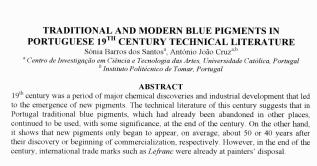
Article: blue pigments in Portuguese 19th century technical literature (2009)


Title: Traditional and modern blue pigments in Portuguese 19th century technical literature
Author: Sónia Barros dos Santosa, António João Cruz
Reference: Andrea Macchia, Ernesto Borrelli, Luigi Campanella (org.), YOCOCU 2008. Youth in Conservation of Cultural Heritage. Proceedings, Rome, Italian Association of Conservation Scientists - Italian Society of Chemistry, 2009, pp. 44-50
Link: html, pdf (2.6 Mb)

Abstract:
19th century was a period of major chemical discoveries and industrial development that led to the emergence of new pigments. The technical literature of this century suggests that in Portugal traditional blue pigments, which had already been abandoned in other places, continued to be used, with some significance, at the end of the century. On the other hand, it shows that new pigments only began to appear, on average, about 50 or 40 years after their discovery or beginning of commercialization, respectively. However, in the end of the century, international trade marks such as Lefranc were already at painters' disposal.


03 April 2010

Article: visible spectrum imaging for pigment identification (2002)


Title: The use of multi-channel visible spectrum imaging for pigment identification
Authors: Roy S. Berns and Francisco H. Imai
Reference: 13TH Triennial Meeting Rio de Janeiro Preprints, ICOM Committee for Conservation, 2002
Pages: 217-222
Download: http://www.art-si.org/... (pdf, 2.27 Mb)

Abstract:
Visible reflectance spectrophotometry is a valuable tool in art conservation. In particular, the spectral data can be used to evaluate potential pigment combinations for inpainting to insure metamerism is minimized. This is a critical criterion because of the wide range of museum lighting and observers, including imaging devices. Recently, a new method of pigment selection for inpainting was developed that successfully minimizes metamerism. Normally, small-aperture spectrophotometers are used. An experiment was performed to test whether this technique could be used with direct digital capture of artwork. Multi-filter colour images were used to estimate spectral reflectance factor. The accuracy of the spectral estimation depended on the spectral properties of the system calibration target. The new method of pigment selection was able to correctly identify pigments from the estimated spectra in many cases. The reported results focus on blue pigments, often a cause of significant metamerism when poorly matched.


In case you would like to share this publication, please acknowledge this source.

Kubelka-Munk Theory for Artist Acrylic and Oil Paints (2006)


Title: Further Investigations of Colorant Database Development for Two-Constant Kubelka-Munk Theory for Artist Acrylic and Oil Paints
Authors: Yonghui Zhao, Roy S. Berns
Year: 2006
Pages: 14
Download: http://www.art-si.org/... (pdf, 6.74 Mb)

Abstract:
It is a common practice to prepare tint ladders of each colorant consisting of five or more concentrations in order to develop a colorant database for instrumental-based color matching, characterization of optical properties of a coloration system, and pigment mapping. For two-constant Kubelka-Munk theory, the unit absorption and scattering coefficients for each colorant can be solved by the linear-least-squares method using all the samples in the tint ladder. The objective of this research was to find the minimum number of samples in order to characterize each colorant. For the purpose of pigment identification, a pure pigment (masstone) and a mixture sample of unknown concentration with white paint were sufficient to describe each pigment qualitatively. On the other hand, pigment mapping, which resolves not only colorant constituents but also their concentrations, required a masstone and a mixture sample of known concentration, preferably 40 % to 60 % with white paint, to quantitatively characterize each colorant. For either case, only two samples were needed, which greatly simplified the process to develop a colorant database. This was tested using artist acrylic and oil paints.


In case you would like to share this publication, please acknowledge this source.

02 April 2010

Article: characterization of pigments by reflectance spectroscopy (2008)


Title: Optical characterization of pigments by reflectance spectroscopy in support of UV laser cleaning treatments

Authors: S. Acquaviva, E. D’Anna, M. L. De Giorgi, A. Della Patria, L. Pezzati
Reference: Applied Physics A, Volume 92, Number 1, July 2008, pp. 223-227
DOI: 10.1007/s00339-008-4486-2
Download: http://www.ino.it/... (pdf, 344 Kb)

Abstract:
The study of optical properties of artwork materials is of fundamental importance for laser-based restoration techniques. In this work, reflectance spectroscopic measurements and colorimetric analyses of painted wooden models were performed to discriminate between pigments on the basis of their spectral features. In particular, the spectral reflection factors of different white pigments were recorded with a fibre optics reflectance spectroscopy module, both before and after excimer laser (248 nm) irradiation. Colour data were obtained and monitored with an integrating sphere spectrophotometer and expressed with the CIE L*a*b* colour coordinates. Moreover, the laser-induced morphological changes of the samples were investigated by scanning electron microscopy.


In case you would like to share this publication, please acknowledge this source.

09 February 2010

Molecular studies of asphalt, mummy and Kassel earth pigments (2004)


Title: Molecular studies of asphalt, mummy and Kassel earth pigments : their characterisation, identification and effect on the drying of traditional oil paint
Author: Georgiana M. Languri
University: University of Amsterdam
Year: 2004
Type of document: PhD thesis
Download: http://www.amolf.nl/... (pdf)
New link:
http://dare.uva.nl/...
(pdf)


From the Summary:
The organic black and brown pigments, asphalt, mummy and Kassel earth, are often used or claimed to have been used by painters in the 19th century. In particular paintings from the 19th century show paint defects that can be associated with these pigments. Examples of poor drying of the oil are observed as formation of premature cracks and phenomena, such as migration or sinking-in of layers. These phenomena are already reported in the contemporary literature, but they are also reported nowadays by conservators and restorers investigating 19th-century paintings. With all the indications about the negative influence of asphalt, Kassel earth and mummy pigments on the condition and aesthetic quality of the paintings, surprisingly little or no molecular evidence is so far available. What exactly are these pigments? Is it possible to identify them in painting samples? Are they the reason why the oil binding media dries so poorly? These are questions addressed in this dissertation.

Table of Contents (short version):

1. General introduction
2. Asphalt: Characterisation of molecular markers and biomarkers in the 19th-century Hafkenscheid asphalt pigment
3. Mummy: Characterisation of molecular markers and biomarkers in the 19th-century Hafkenscheid mummy pigment
4. Kassel earth: Characterisation of molecular markers and biomarkers in a series of Kassel earth pigments
5. On poorly drying 19th-century oil paints: reference, materials, model systems and paintings
Annex A. Mass Spectrometry as a micro-analytical method to study Kassel earth (Vandyke brown) pigments in oil paint
Annex B. Monitoring the effects of traditional 19th-century additives on the chemical drying of oil paint by Mass Spectrometry

In case you would like to share this publication, please acknowledge this source.

04 February 2010

Studies of artists' organic pigments (2003)


Title: Laser desorption mass spectrometric studies of artists' organic pigments
Author: Nicolas Wyplosz
University: University of Amsterdam
Year: 2003
Type of document: PhD thesis
Download: http://www.amolf.nl/... (pdf)
New link: http://dare.uva.nl/... (pdf)

From the Introduction:
The technical investigation of organic pigments in easel paintings is not without problems. Pigments have complex chemical compositions; details of their manufacturing processes are generally unknown and dramatic transformations of the colouring properties are observed with the passing of time. Characterisation of the chemical composition is greatly complicated by the particularly small size and complex arrangement of the samples available for analysis. Microscopic samples are preferably studied as paint cross-sections, but the finest methods of molecular analysis available today (chromatography and mass spectrometry) are not very compatible with this sampling method. In practice, investigation of organic pigments in cross-sections remains often inconclusive by the lack of a suitable method of analysis. This dissertation explores a new approach to the analysis of organic pigments found in easel paintings, using laser desorption mass spectrometry (LDMS). LDMS makes it possible to investigate the surface of paint cross-section with a spatial-resolution down to 10 mm utilising the analytical method of mass spectrometry.

Table of Contents:


Chapter 1 : Introduction
1.1. Introduction
1.2. Structure of an easel painting
1.3. Traditional and modern organic pigments
1.4. Categories of pigments under investigation
1.5. Deterioration of organic pigments
1.6. Investigation of organic colouring materials in conservation science
1.7. LDMS of organic colouring materials, a rationale
1.8. Thesis outline
1.9. Main results and implications for painting studies

Chapter 2: Principles and instrumentation of LDMS
2.1. Introduction
2.2. Laser Desorption Mass Spectrometry for Surface Analyses
2.3. Principles of LDMS
2.4. Instrumentation for the analysis of paint cross-section
2.5. Conclusion

Chapter 3: An experimental strategy for LDMS of paint materials

3.1. Introduction
3.2. Sample and sample mounting
3.3. Laser-sample interaction
3.4. Shot-to-shot variations
3.5. TOF-MS versus ITMS: pressure and time-scale
3.6. Ion collection in the ITMS analyser: LMCO
3.7. CID experiments with the ITMS analyser
3.8. Conclusion

Chapter 4: LDMS of flavonoids
4.1. Introduction
4.2. Flavonoid pigments
4.3. Experimental
4.4. Characterization of flavonoid aglycones with LDMS
4.5. Multiple-stage LDI–ITMS
4.6. Characterisation of flavonoid-O-glycosides
4.7. Analysis of complex samples
4.8. Analysis fibres dyed with flavonoids
4.9. Investigation of cross-sectioned samples
4.10. Conclusion

Chapter 5: LDMS of anthraquinones
5.1. Introduction
5.2. Anthraquinone pigments
5.4. LDI and MALDI of Alizarin
5.5. Alizarin lake in oil paint
5.6. Analysis of natural dyed fibres
5.7. Conclusion

Chapter 6: LDMS of indigoids
6.1. Introduction
6.2. Experimental
6.3. Analysis of synthetic indigo
6.4. Analysis of natural indigos
6.5. LDMS of indigo at the surface of dyed fibres
6.6. LDMS of indigo in oil paint
6.7. Spatially- resolved LDMS of cross-sections
6.8. Conclusion

Chapter 7: LDMS of modern synthetic pigments
7.1. Introduction
7.2. Samples
7.3. Experimental conditions
7.4. Analysis of reference samples
7.5. Acrylic polymer emulsions and oil paints
7.6. Spatially- resolved LDMS analysis of cross-sectioned paint samples
7.7. Conclusions

Chapter 8: Surface preparation of paint cross-sections
8.1. Introduction
8.2. FTIR-imaging and LD-ITMS
8.3. Evidence of smearing
8.4. A new sample preparation
8.5. Analyses after polishing
8.6. Conclusion
8.7. Acknowledgements

Bibliography