Showing posts with label museum. Show all posts

20 April 2012

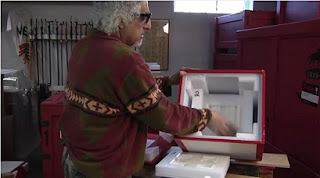
Art Packing Video Tutorial (2012)


Title: Art Packing Video Tutorial
Uploaded by: ArtInstituteChicago
Date: 3 April 2012
Link: http://www.youtube.com/...

12 December 2010

Safe Handling of Plastics in a Museum Environment (2010)


Title: Safe Handling of Plastics in a Museum Environment
Author: Jia-sun Tsang
Citation: WAAC Newsletter 32(2), pp. 16-22
Year: 2010
Link: http://hdl.handle.net/10088/11186 (pdf, 3.64 Mb)


Abstract:
Research on the theory and mechanics of plastics degradation and conservation has made steady progress over the years, yet regarding the safe handling of plastics, current knowledge and practices are long overdue for an update. The purpose of this paper is to translate the science of plastics degradation into practical guidelines for the safe handling and conservation of plastics in a museum environment. The safety practices outlined here are based on an analysis of naturally aged plastics in museum collections, and are relevant to the specific problems faced by conservators, curators, and museum specialists who must handle and evaluate many types of plastic materials.


10 September 2010

Dans la lumière des terrasses (2) (2010)


Title: Dans la lumière des terrasses: Le Subak Museum à Sanggulan : quel musée pour la civilisation du riz? (2e volet)
Author: Marc-Antonio Barblan
Reference: Le Banian, N. 9, juin 2010, pp. 33-61
Link: click here (pdf, 11.2 Mb)

Note: Made available upon request of the author

09 September 2010

Dans la lumière des terrasses (1) (2009)


Title: Dans la lumière des terrasses: Paysage culturel balinais, Subak Museum et patrimoine mondial (1er volet)
Author: Marc-Antonio Barblan
Reference: Le Banian, N. 7, juin 2009, pp. 80-101
Year: 2009
Link: click here (pdf, 9.98 Mb)


Note: Made available upon request of the author

02 June 2010

Proceedings: Multidisciplinary Conservation: A Holistic View For Historic Interiors (2010)


Title: Multidisciplinary Conservation: A Holistic View For Historic Interiors
Editors: Elsje Janssen, Mariabianca Paris, Malgorzata Sawicki, Kate Seymour, and Andrew Thorn
Reference: Proceedings of the Joint Interim Conference, Rome 23-26 March 2010
Link: http://www.icom-cc.org/... (pdf)

From the Preface:
The topic of this meeting is an important one, as it poses particular challenges due to the constraints often imposed by the building fabric. In addition, the conservation of historic interiors not only draws from many conservation specialisations but also from many other fields. Furthermore, historic buildings and their interiors form part of national heritage of every country and culture. These buildings and their interiors usually consist of multiple facets and materials often altering dramatically throughout their life spans due to change imposed by society, their environment and use. It is through the conservation and restoration of these buildings and the collections therein that the cultural identity of our past can be preserved and transferred to our future. It is thus essential to consider these entities in a holistic manner using a multidisciplinary collaborative approach, without imposing any sense of hierarchy for the conservation of the individual artefacts or collections housed within.


Table of contents (only the papers with pdf are indicated):

PAPERS

Session 1: Historic interiors and wide ranging conservation projects

The integrated approach of Monumentenwacht in Flanders (Belgium): a model for implementing participative preventive conservation for historic interiors, V. Meul

The Attingham re-discovered project of improvements to historic interiors, S. Kay, C. Sitwell, C. Hughes, A. Bush

Conservation works in refectories in the Castle of the Teutonic Order in Malbork: between history and aesthetic functionalism, M. Kozarzewski, A. Wielocha

The Sacristy of the Mosteiro de São Martinho of Tibães (Portugal): to exemplify the preservation of a unique historic ensemble, A. Le Gac, M. J. Dias Costa, I. Dias Costa

Textile furnishings in historic interiors: recreating the past, I. Campagnol

Conservation of Chinese Room in Wilanów Palace in Warsaw as a result of multidisciplinary research project, I. Zadrozna, A. Guzowska, E. Jezewska, A. Leskiewicz-Laudy

Restoration of the House of Owls at Villa Torlonia in Rome. An example of Architecture and Decorative Arts, A. Campitelli

Evaluation of conservation options for decoratively painted wood, Mission San Miguel Arcangel, D.W. Porter, R.W. Anthony, K. D. Dugan

Diagnosis of cultural heritage wooden structures. Two cases of studies, E. Maurin, P. Galimard

The mural paintings in S. Maria Maddalena church in Camuzzago: the conservation process, F. Carlini, D. Foppoli, M. Gasparoli, G. Miani, R. Moioli, E. Rosina

Session 2: Museums and private residences: principles of conservation

Upholstery conservation in the Acton Collection, Villa La Pietra, Florence, C. Beyer, C. Perrone Da Zara

Villa Abegg – from private residence to museum, A. Jolly, C. Kienzler

The restoration of Mrs. Mills’s rooms at Staatsburgh State Historic Site: an American Gilded Age example of the holistic view for historic interiors, D. Lee Trupin, M. Moore


Session 3: Museums and private residences: principles of conservation

The conservation campaign at Villa Stibbert. Case studies, K. Achengreen Piacenti

Historical and methodological aspects of the 18th century French gilt leather tapestry restoration in a historic house: the Maison Mantin project (Moulins, France), C. Bonnot-Dicone, J.P. Fournet, B.H. Paponaud

The Good Fight: Conservation of the Rouse Hill House & Farm interiors, M. Scott

Session 4: Interdisciplinary issues

Wallpaper and textile superposed–destination and presentation after removal. The Chinese boudoir ceiling conservation from the château d’Issou (Yvelines, France), J. B. Martin

Upholstery, how to deal with the textile coverings? Case-study: Project Weissensteinflügel, J. Dummer

Interdisciplinary collaboration to understand and recreate the splendour of the Marble Closet at the Little Castle Bolsover, H. Hughes

Marriage of Conservators at Paris' 19th Arrondisement City Hall, M. Dubost, A.M. Geffroy, E. Hincelin, M. Margez, E. Paris

Session 5: Preserving original context while maintaining a functional role

Strozzi Sacrati Palace in Florence 'a museum itself'. Tapestries and wallpaper conservation treatment, P. Crisostomi, M. Giorgi, G. Palei, M. Pandolfini, "SPIRA S.R.L."

United Nations – uniting professions?, M. Bergstrand

Decoration of an Italian theatre after the Unification of Italy in 1870: technical implementation and conservation after the great wars in an earthquake zone, G. De Cesare

Exploring the approach to the conservation and restoration of Taiwan’s traditional temple artefacts, Y. Tung, S. Hsieh

Session 6: Preventive conservation, care and maintenance

Danish church interiors and their change in colour appearance due to repeated repainting of the furniture, K. Vestergaard Kristiansen

Cleaning, condition surveying and maintenance: house keeping Swedish style, A. Hallström, E. Hedhammar, L. Tamm

The WEB Environmental Data Sheet for museum and temporary exhibitions, C. Cacace, E. Giani, A. Giovagnoli, L. Gordini, M.P. Nugari

Applying preventive conservation recommendations for silk in historic houses, N. Luxford, D. Thickett, P. Wyeth

Painted wood as climate indicators? Experiences from a condition survey of painted wooden panels and environmental monitoring in Läckö Castle, a dehumidified historic building, C. Bylund Melin, J. Bjurman, M. Brunskog, A. Von Hofsten

Session 7: Cultural property: changes in the original context

The Gallery of the former town hall of Amsterdam. An interrelation between painting, architecture and light?, E. Froment, M. Van Eikema Hommes, A. Zwagerman, L. Megens, M. De Keijzer

A Rococo room from a house along the Amsterdam canals on display in the New Rijksmuseum, P. Van Duin

Old friends, new places. relocation and conservation of two decorated doors by Australian artist, Donald Friend and Balinese carver, I Made Jojol, D. Hinton

Session 8: Composite material artefacts: conservation projects

The conservation of a Chinese Coromandel lacquer panel from the collection of Villa La Pietra, P. Hatchfield

From historic interiors to the conservation studio: a route to knowledge of a Japanese multimaterial textile from the Stibbert Museum in Florence, S. Conti, L. Triolo, M. Rizzi, F. Civita, N. Kato

Church of the Transfiguration of Our Lord in Tallinn and the conservation of its carved-wood iconostasis, M. Lillepruun, K. Sibul

Technical study of polychrome clay sculptures from the Buddhist temple complex at Nako, Himachal Pradesh, North India, T. Bayerova, M. Gruber, G. Krist

Session 9: Materials and artefacts: technical and scientific update

Cleaning of tanned leather: testing with Infra Red Spectroscopy and SEM-EDAX, K. Malea, S.C. Boyatzis, M. Kehagia

Analysis and preservation of an ancient alum tawed parchment, I. Rabin, R. Schütz, E. Kindzorra, U. Schade, O. Hahn, G. Weinberg, P. Lasch

Mechanical characteristics of aged Hinoki (Chamaecyparis obtusa Endl.) wood from Japanese historical buildings, M. Yokoyama, J. Sugiyama, S. Kawai

Alteration of gilts on medieval mural paintings, F. Daniel, A. Mounier


POSTERS
SESSION 1: General: Historic Interiors

The Ninfeo of Sacchetti Palace in Rome

Rome, Villa Farnesina alla Lungara, the ‘Frieze’ hall. The conservation of the frieze by Baldassarre Peruzzi and the recovery of the 19th century decoration

Conserving traveling wallpaper. Advanced distribution in the mid to end 18th century reflected in the historic interior

The integration of conservation strategies for the interiors of Juanqinzhai in the Forbidden City, Beijing

Whose blue? The true story behind the sky-blue roof of St. Pancras International Station

SESSION 2: Textiles Working Group

Conservation of a presumably embroidered oriental silk wall decoration with special consideration to the problematic nature of the removal of soot deposits and paint splashes

Nichelino (Torino) Palazzina di Caccia di Stupinigi: the textiles conservation project

Conservation and weave analysis reveals another layer of history on 17th century wallhangings at Ham House, Surrey, England

The Hunt of the Frail Stag: analysis, conservation, and display of five medieval tapestry fragments

SESSION 3: Leather and Related Materials Working Group

Analysis of acid deterioration of leather

Gilt leather wall hangings in the Stibbert Museum of Florence

Ariccia: in the Baroque country dwelling of the Chigi family, gilt leather and archival documentation

The condition of the gilt leather wall hangings in the Palazzo Chigi, Ariccia, Italy

Identification and symbology of plant species in gilt and painted leather

SESSION 4: Sculpture, Polychromy and Architectural Decoration Working Group


The Balla House in Rome: futurist context and industrial painting media

The church of Saint Savior in Prizren (Kosovo): a double church

The conservation of technical fixtures in historic buildings

The sequence of inscriptions in the Hall of Mirrors revealed by cross-section

Unconventional thermographic and ultrasonic tests for a case study of the stone decoration of St. Leo Chapel in Bova, Reggio Calabria-Italy

Establishing a conservation project for the High Altar by Bernt Notke (1483). The preliminaries

Madonna del Rosario in N.S. della Consolazione Church, Genoa: science dealing with conservation

Glossy and dark blue surfaces on 13th century Mosan wooden sculptures

A new insight into the 18th century gold leaf from a Baroque altarpiece

Projecto Retablo. An interactive tool on material expressions, cultural contexts and conservation approaches for wooden polychromed altarpieces

Kunstmarmor: an unknown presence in architectural interiors of the second-half of the nineteenth century

SESSION 5: Wood, Furniture, and Lacquer Working Group

Restoration and scientific investigation of exquisite historic furniture from the collections of the Prince of Liechtenstein

The Stupinigi Library’s boiseries: two centuries of changes and adjustments

The impact of the frame: one painting’s journey within the Art Gallery of New South Wales

Gilding techniques: case study of the chairs of the gilt room of Malmaison Castle

The challenge of conserving furniture with missing parts: the case study of a bed from the Byzantine and Christian Museum of Athens, Greece

An experimental study of selected gap-fillers for wood restoration

11 May 2010

The Future of Museums and Libraries (2009)


Title: The Future of Museums and Libraries: A Discussion Guide (IMLS-2009-RES-02)
Publisher: Institute of Museum and Library Services
Year: 2009
Pages: 36
Link: http://www.imls.gov/... (pdf, 254 Kb)

From the Introduction:
The Institute of Museum and Library Services (IMLS) is committed to bringing together museums and libraries across the country for conversations dedicated to developing a better understanding of the roles of libraries and museums as providers of public service to communities. The Future of Libraries and Museums in the 21st-Century Planning Meeting, which took place July 7–8, 2008, in Washington, D.C., was convened by the National Academy of Sciences and supported by IMLS to bring together voices across and outside the library and museum fields to debate, discuss, and question the future of museums and libraries and gain insight into how the conversation could unfold in subsequent discussions in the field at large. This meeting brought together leaders from across the disciplines in the library, museum, research, scientific, technology, and education fields to help define the central issues, challenges, and opportunities that libraries and museums are likely to face in the coming decades.


Table of Contents:

Introduction
The Planning Meeting: Insights, Questions, & Possibilities
Discussion Theme #1: Changing Definitions & Roles of Museums and Libraries
Discussion Theme #2: Shifts in Power & Authority
Discussion Theme #3: Museums & Libraries as the “Third Place”
Discussion Theme #4: Technology & Policy Development
Discussion Theme #5: 21st-Century Learning & Information Use
Discussion Theme #6: New Models & Structures for Collaboration
Discussion Theme #7: Planning for a Sustainable Future
Discussion Theme #8: Metrics for Evaluating Service & Impact
Discussion Theme #9: The 21st-Century Museum & Library Workforce
Summary and Conclusion: Where Do We Go from Here?
Planning Meeting Participants
Bibliography


02 April 2010

Article: Museums, Disruptive Technologies and Organisational Change (2008)


Title: Making Ways for Change: Museums, Disruptive Technologies and Organisational Change
Author
: Darren Peacock

Journal
: Museum Management and Curatorship

Year
: 2008

Volume
: 23
Issue: 4
Pages
: 333-351

DOI
: 10.1080/09647770802517324

Download
:
http://www.informaworld.com/... (pdf, Kb)

Abstract
:
This paper aims to stimulate discussion about the nature of technology-related organisational change and how it is managed within museums. It argues that how we think about and understand change affects our ability to anticipate, shape and direct it. Drawing upon perspectives from sociology, information systems, management and organisation theory, this paper explores how we might understand and better manage change within the museums sector generally and, in particular, that which arises in our use of digital information and communication technologies (ICTs). It advocates the conscious use of theory, particularly organisational theory, to encourage new perspectives on organisations and the challenge of change represented by technology. Organisational theory particularly that informed by the 'new science' of complexity provides a rich source of insights about the nature of change which have so far been lacking in the discussion of digital cultural heritage within museums.


In case you would like to share this publication, please acknowledge this source.

24 March 2010

The Participatory Museum (2010)


Title: The Participatory Museum
Author: Nina Simon
Licence: Creative Commons Attribution-NonCommercial 3.0
Link: http://www.participatorymuseum.org/... (html)

From the Preface:
This book presents techniques for cultural institutions to invite visitor participation while promoting institutional goals. Community engagement is especially relevant in a world of increasing participatory opportunities on the social Web, but it is not new. Arguments for audience participation in cultural institutions trace back at least a hundred years. [...] I wrote this book not to update or stake claim to these ideas, but to present specific techniques and case studies to make them actionable in contemporary institutions. This doesn’t require flashy theaters or blockbuster exhibits. It requires institutions that have genuine respect for and interest in the experiences, stories, and abilities of visitors.


Table of Contents:

Preface: Why Participate?

Part 1: Design for Participation
Chapter 1: Principles of Participation
Chapter 2: Participation Begins with Me
Chapter 3: From Me to We
Chapter 4: Social Objects

Part 2: Participation in Practice
Chapter 5: Defining Participation at Your Institution
Chapter 6: Contributing to Institutions
Chapter 7: Collaborating with Visitors
Chapter 8: Co-creating with Visitors
Chapter 9: Hosting Participants
Chapter 10: Evaluating Participatory Projects
Chapter 11: Managing and Sustaining Participation

Imagining the Participatory Museum
Acknowledgements
Selected Bibliography

20 March 2010

Getting more out of Museums (2010)


Title: Sharper investment for changing times: Getting more out of Museums, Library and Archives
Publisher: Museums, Library and Archives Council
Year: 2010
Pages: 24
Link: http://www.mla.gov.uk/...
Download: http://www.mla.gov.uk/... (pdf, 3.7 Mb)


Description:
“Cuts to museums, libraries and other cultural services are unpalatable – we must resist them in favour of imaginative alternative solutions. Our call, to government and councils, is to recognise that cultural services can help communities recover from the impact of the recession." Sir Andrew Motion said today. “But financial difficulties will bring change whether we like it or not – those delivering the service must not be left unsupported with less cash and limited choices. That is why the MLA has today published Sharper Investment for Changing Times.


Table of Contents (short version):

1. Introduction
2. The value of museums, libraries and archives
3. How we can get more out of our museums, libraries and archives
4. How can the necessary changes be nationally supported?
5. What would the results look like?
Appendix: About the MLA


In case you would like to share this publication, please acknowledge this source.

16 March 2010

Pesticide Mitigation in Museum Collections (2010)


Title: Pesticide Mitigation in Museum Collections: Science in Conservation
Editors: A. Elena Charola and Robert J. Koestler
Publisher: Smithsonian Institution Scholarly Press
Year: 2010
Pages: 72
Link: http://www.sil.si.edu/...
Download: http://www.sil.si.edu/... (pdf, 4.54 Mb)

Abstract:
The Smithsonian Museum Conservation Institute Workshop on Pesticide Mitigation was one of the first professional meetings dedicated to current research on removing pesticide residues from museum objects. Seven papers were presented at the workshop, and two more were added to introduce topics not focused on during the meeting but of significant importance when considering actual application of any of these methods.
The aim of the workshop was to bring together conservators, scientists, and even industry representatives to discuss the complex issues associated with pesticide removal from artifacts and to provide representative examples of the research and work being carried out at different institutions in the United States and abroad. Among the issues explored were possible methods and techniques that might become useful in the museum conservation field to reduce, mitigate, clean, or remediate undesirable pesticides on objects. The meeting also served to inform conservators and scientists in the Smithsonian Institution of the wide range of approaches that are currently being tested and that might prove useful in the future.
Topics covered in the presented papers included removal of mercury and arsenic contamination with α-lipoic acid; the treatment of Haudenosaunee medicine masks with surface active displacement solutions; the possibility of using mercury-resistant bacterial communities to remediate contamination; solvent extraction through the use of special solvents such as hydrofluoroethers; carbon dioxide as a cleaning fluid either in liquid or in supercritical state; and novel cleaning techniques either through the use of additives to improve the efficiency of liquid or supercritical CO2 cleaning, other gases in a supercritical state, or other techniques such as fluidized beds. The introduction of novel techniques at the workshop was encouraged in order to broaden the range of promising methods that might improve the technology of pesticide mitigation or remediation. The two supplemental papers discuss pesticide analysis on objects and safety measures that should be implemented by institutions with contaminated collections.

Table of contents:

Pesticide Remediation in Context: Toward Standardization of Detection and Risk Assessment, Odile Madden, Jessica Johnson, Jae R. Anderson

Aqueous α-Lipoic Acid Solutions for Removal of Arsenic and Mercury from Materials Used for Museum Artifacts, Peggi S. Cross, Nancy Odegaard, Mark R. Riley

Solvent Cleaning of Fragile Artifacts without Mechanical Agitation, Robert Kaiser

Mitigation of Surface Contaminants on Haudenosaunee Medicine Masks, Peter A. Reuben

Bacterial Removal of Mercury from Museum Materials: A New Remediation Technology?, Timberley M. Roane, Lisa J. Snelling

Liquid and Supercritical Carbon Dioxide as a Cleaning and Decontamination Agent for Ethnographic Materials and Objects, Helene Tello, Achim Unger

Pesticide Extraction Studies Using Supercritical Carbon Dioxide, Werner S. Zimmt, Nancy Odegaard, Teresa K. Moreno, Rachael A. Turner, Mark R. Riley, Bo Xie, Anthony J. Muscat

The Potential for Adapting Some Cleaning Methodologies to Pesticide Removal from Museum Objects, Werner S. Zimmt, Nancy Odegaard, David R. Smith,

Discussion: Mitigation of Contaminated Collections, R. Eric Hollinger, Greta Hansen

Appendix: Common Museum Pesticides

13 February 2010

Museum Data Exchange (2010)


Title: Museum Data Exchange: Learning How to Share
Author: Günter Waibel, Ralph LeVan and Bruce Washburn
Publisher: OCLC Research

Year: 2010
Download: http://www.oclc.org/... (pdf, 2 Mb)
Link: http://www.oclc.org/...

Description:
This report describes the outcomes of a project funded by a grant from The Andrew W. Mellon Foundation to further develop standards for museum data exchange.
OCLC Research and nine art museums worked together on the Museum Data Exchange project to create tools for data sharing, build a research aggregation of museum records and analyze the aggregation to determine in which areas museums should invest in to upgrade their records, as well as what automated processes could be utilized to harmonize descriptions for retrieval. Their work resulted in the establishment of an infrastructure for standards-based metadata exchange for the museum community and modeled data sharing behavior among participating institutions, details of which are included in the report.


In case you would like to share this publication, please acknowledge this source.

04 February 2010

Paint dosimeters as tools to monitor the museum environment (2001)


Title: Molecular changes in egg tempera paint dosimeters as tools to monitor the museum environment
Author: Oscar F. van den Brink
University: University of Amsterdam
Year: 2001
Type of document: PhD thesis
Download: http://www.amolf.nl/... (pdf, 7.06 Mb)


Table of Contents (short version):

1. Introduction
2. Determination of the degree of chemical change in museum exposed test paintings by mass spectrometry and discriminant analysis
3. DTMS and DA of nine dosimetric test systems
4. Dosimetry of the environment in various museums: Interpretation of the results of the field studies
5. Cholesterol oxidation products in light-aged egg tempera
6. MALDI-FTMS analysis of oxigenated triglycerides and phosphatidylcholines in egg tempera dosimeters
7. Electrospray ionisation FT-ICR-MS(MS) of light-aged egg glycerolipids
8. Recommendations for further work on paint-based dosimetry and outlook

Documentation of Museum Collections (2010)


Title: Documentation of Museum Collections. Why? How? Practical Guide
Author: Anne Ambourouè Avaro, with the contribution of Gaël de Guichen and Alain Godonou
Publisher: ICCROM
Year: 2010
Website: http://www.iccrom.org/...
Available in: English (pdf, 347 Kb), Français (pdf, 360 Kb), Español (pdf, 414 Kb)


Description:
UNESCO and ICCROM, together with other partners, have prepared a draft practical guide for basic documentation of collections in small museums and would like your help in improving it.
If you work for a museum which has between 5,000 and 8,000 objects and your responsibilities include the inventory and documentation of collections, we welcome your feedback. (for the Evaluation questionnaire, please check the website)


Table of Contents (short version):

Introduction
1- Why document?
2- How to set up a basic manual documentation system from scratch
3- How to reactivate an abandoned or incomplete manual documentation system
4- How to check the inventory
5- How to computerize the system
6- How to maintain the documentation system
Conclusion

16 January 2009

Museums & Society 2034 (2008)


Title: Museums & Society 2034: Trends and Potential Futures
Author: James Chung and Susie Wilkening
Year: 2008
Pages: 20
Website: http://www.futureofmuseums.org/
File: http://aam-us.org/ (PDF, 2.4 Mb)

Description (from the website):
What challenges will society and museums face in the next quarter-century? To find out, the Center for the Future of Museums (CFM) commissioned this discussion paper on social and cultural trends and their potential effect on museums. This paper is designed to be a catalyst – a fact-based platform for further exploration, and refinement rather than the final word on museum trends.

30 November 2008

Airborne Particles in Museums (1993)


Title: Airborne Particles in Museums
Editor: Dinah Berland
Publisher: The Getty Conservation Institute
Year: 1993
Pages: 145
Format: PDF (1.5 Mb)
Link: http://www.getty.edu/...

Table of contents:

Chapter 1. Soiling Due to Airborne Particles
Chapter 2. Characteristics of Airborne Particles Inside Southern California Museums
Chapter 3. Mathematical Modeling of Indoor Airborne Particle Dynamics
Chapter 4. Concentration and Fate of Airborne Particles in Museums
Chapter 5. Measurements of the Rates of Soiling Inside Museums Due to Deposition of Airborne Particles
Chapter 6. Protecting Museum Collections from Soiling Due to Deposition of Airborne Particles

Oxygen-Free Museum Cases (1998)


Title: Oxygen-Free Museum Cases
Editor: Shin Maekawa
Publisher: The Getty Conservation Institute
Year: 1998
Pages: 76
Format: PDF (1.6 Mb)
Link: http://www.getty.edu/...

Table of contents:

Chapter 1. Conservation of the Royal Mummy Collection at the Egyptian Museum, Shin Maekawa
Chapter 2. Protection of Objects from Environmental Deterioration by Reducing Their Exposure to Oxygen, Eric F. Hansen
Chapter 3. Preservation of Historic Materials by Using Inert Gases for Biodeterioration Control, Nieves Valentín
Chapter 4. Design and Construction of the CCI's Hermetically Sealed Display and Storage Case, Shin Maekawa
Chapter 5. Controlled-Environment Cases for the Royal Mummy Collection, Nasry Yousef Iskander
Chapter 6. Preservation of the Original Documents of the Constitution of India, Hari Kishan and Shin Maekawa
Chapter 7. Preservation of the Mummy of an Egyptian Child in a Hermetically Sealed Museum Case in Spain, Shin Maekawa

Building an Emergency Plan (1999)

Title: Building an Emergency Plan: A Guide for Museums and Other Cultural Institutions
Author: Valerie Dorge and Sharon L. Jones
Publisher: The Getty Conservation Institute
Year: 1999
Pages: 281
Link: http://www.getty.edu/...
PDF (3.4 Mb)

Table of contents:


Part I For the Director
Chapter 1 An Introduction to Emergency Preparedness and Response Planning
Chapter 2 The Role of the Director

Part II For the Emergency Preparedness Manager
Chapter 3 The Role of the Emergency Preparedness Manager and the Emergency Preparedness Committee
Chapter 4 Communications
Chapter 5 Training

Part III For the Departmental Team Leaders
Chapter 6 The Safety and Security Team
Chapter 7 The Collections Team
Chapter 8 The Buildings and Maintenance Team
Chapter 9 The Administration and Records Team

28 November 2008

Climate change and museum collections (2008)


Title: Climate change and museum collections (round table discussion)
Venue: 2008 IIC London Congress
Document: http://www.iiconservation.org/... (PDF, 2.5 Mb)
Website: http://www.iiconservation.org/...