
Title: Heritage in the Classroom. A Practical Manual for Teachers
Authors: Veerle De Troyer, Jens Vermeersch, Hildegarde Van Genechten, Klaus Kösters, Pieter Mols, Jacqueline Van Leeuwen, Nicole Vitré, Fabio Pizzicanella and Antonietta Destro
Publisher: Het Gemeenschapsonderwijs
Year: 2005
Pages: 155
File: pdf, 3.88 Mb
Link: http://www.gemeenschapsonderwijs.be/...
Website: http://www.hereduc.net/...
Description (from the website): The HEREDUC handbook contains approaches to heritage in Europe and concentrates on how teachers might integrate heritage education in lessons, in primary as well as secondary schools. The text is written with practical application in mind. The handbook finishes with a series of 34 inspiring practical examples from five European countries and a selective bibliography.
Table of contents (short version):
Chapter 1. A school trip to the past, with an eye fixed on the future
Chapter 2. Heritage education, Europe and identity
Chapter 3. Learning with and from our heritage
Chapter 4. Heritage projects in all measures
Chapter 5. Practical examples
A selected bibliography
 Title: The painter and varnisher's guide, or, A treatise, both in theory and practice, on the art of making and applying varnishes, on the different kinds of painting (...)Author: Pierre François TingryPublisher: J. TaylorYear: 1804Pages: 540Link1: http://www.archive.org/... (several formats)Link2: http://books.google.pt/... (PDF, 23.6 Mb)Table of contents (short version):PART THE FIRSTChapter I. Historical account of the nature and properties of the substances which form the basis of varnishes, and of the external qualities by which the best kinds may be knownChapter II. Of the fluids which serve as an excipient or vehicle to varnish, and tvhich painters denote by the improper name of solventsChapter III. General observations on varnishes; with a distribution of them into five genera, determined by their nature and state of consistenceChapter IV. General observations and precepts respecting the preparation of varnish on a large scale. Description of an alembic with a balneum mariae, the use of which prevents all those accidents that frequently accompany the making of varnish Chapter V. Observations on the influence which the solar light has to render essence of turpentine proper for the solution of copal, so as to compose a durable and colourless varnishPART THE SECONDChapter I. Historical account of the colouring substances used in painting, with a description of the processes employed to extract them, and of the methods of preparing or modifying themChapter II. Philosophical account of the origin of colours, applied to material colours, simple and compound; ivith a description of the processes which art employs to vary the number and richness of the tints resulting from a mixture of themChapter III. Of the extent which may be given to the use of the turpentine copal varnishes Nos. 18. and 22., by impregnating them with various solid colouring parts, transparent and proper for answering the purpose of glazing on metallic laminae, smooth ornamented; for imitating transparent enamel, and for repairing those accidents which frequently happen to enamelled articlesChapter IV. Precepts respecting the application of varnishes, coloured or not coloured, which the artist or amateur ought always to keep in remembrance. Of the different kinds of painting. Of varnihes linen and silkChapter V. On painting in distemper. Sising. Composition of colours or distemper. Geeral precepts in regard to this branchof the artChapter VI. Of the instruments necessary in the art of varnishing. Observations on the use of some of them

Title: Reporting Highlights of the De Mayerne Programme
Editors: Jaap J. Boon and Ester S.B. Ferreira
Publisher: Netherlands Organisation for Scientific Research (NWO)
Year: 2006
Pages: 134
ISBN: 90-77875-14-X
Link: http://www.nwo.nl/... (PDF, 2.21 Mb)
Table of Contents:
The De Mayerne programme: breaking new grounds for art science and conservation in the 21st century, J. Wadum
Surrealism in science: the difference between analysis and analysis, J. Wouters
Processes inside paintings that affect the picture: chemical changes at, near and underneath the paint surface, J.J. Boon
Exploring the application of solid-state Nuclear Magnetic Resonance to the study of the deterioration of paintings, Michiel A. Verhoeven, L. Carlyle, J. Reedijk and J.G. Haasnoot
On metal soap related colour and transparency changes in a 19th C painting by Millais, Y. Shimadzu and K.J. van den Berg
Chemical Characterisation of thin intermediate layers: Case study of a sample from the 15th century painting The Descent from the Crossby Rogier van der Weyden, E.S.B. Ferreira, R. Morrison, K. Keune, and J.J. Boon
Historically Accurate Reconstructions of Oil Painters’ Materials: An overview of the Hart Project 2002-2005, L. Carlyle
Various approaches to van Gogh technical studies; common grounds? E. Hendriks, S. Constantin, B. Marino
Fading of red lake paints after vincent van Gogh – an interdisciplinary study involving three De Mayerne projects, K.J. van den Berg, A. Burnstock, L. Carlyle, M. Clarke, E. Hendriks, R. Hoppenbrouwers, J. Kirby and I. Lanfear
Multidisciplinary research on the paintings ensemble in the Oranjezaal of the Royal Palace Huis ten Bosch, A. van Grevenstein-Kruse
Recipe databases for historical oil painting materials: Winsor & Newton Archive, M. Clarke and L. Carlyle
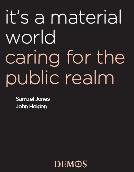
Title: It's a Material World: Caring for the public realm
Authors: John Holden, Samuel Jones
Publisher: Demos
Year: 2008
ISBN: 978-1-906693-077
Website: http://www.demos.co.uk/...
Link: http://www.demos.co.uk/... (PDF, 2.34 Mb)
Description: What parts of our culture do we value and want to protect? This pamphlet explores the future of heritage conservation, and why to survive it must involve everyone. The choice of what things to conserve and how to conserve them simultaneously reflects and creates social value. This pamphlet demonstrates the social value of caring for the material world, and highlights the importance of conservation as being integral not only to the culture and heritage sector but also to social well-being.
Contents:
1 Caring for the material world
2 Conservation and its values
3 The UK conservation sector
4 Conservation under threat
5 The current contribution of conservation
6 A crisis for conservation education?
7 Conservation and the wider world
8 Projecting a spectrum of conservation
9 Building capital from interest
10 Conclusions and recommendations
 Title: From Gray Areas to Green Areas: Developing Sustainable Practices in Preservation Environments, Symposium Proceedings
Editor: Melissa Tedone
Venue: 1-2 November 2007, School of Information's Kilgarlin Center for Preservation of the Cultural Record at the University of Texas, Austin
Year: 2007
Website: www.ischool.utexas.edu/...
Table of contents:
What Will the Cultural Record Say About Us? The stewardship of culture and the mandate for environmental sustainability, Michael C. Henry (pdf, 37Kb)
Going Green in Museums: A Conservator's View, Paul Himmelstein and Barbara Appelbaum (pdf, 18Kb)
From Japanese Tradition: Is /Kura/ a Model for a Sustainable Preservation Environment?, Kazuko Hioki (pdf, 581Kb)
Sustainability Means Less is More, Joachim Huber (pdf, 54Kb)
Providing Safe and Practical Environments for Cultural Property in Historic Buildings...and Beyond, Richard L. Kerschner (pdf, 508Kb)
Sustainable Practices for Conservation Environments, William P. Lull (pdf, 47Kb)
Real and Relevant Green Building, Peter L. Pfeiffer (pdf, 38Kb)
Specifying Storage Environments in Libraries and Archives, James Reilly (pdf, 33Kb)
Pennsylvania's Rare Collections Library: Design Overview, Cornelius J. Rusnov (pdf, 48Kb)
From Institutional Mission to Sustainable Outcome:Cultivating Stewardship Through the Planning and Design Process, Laurie Zapalac (pdf, 897Kb)



 Posts
Posts


